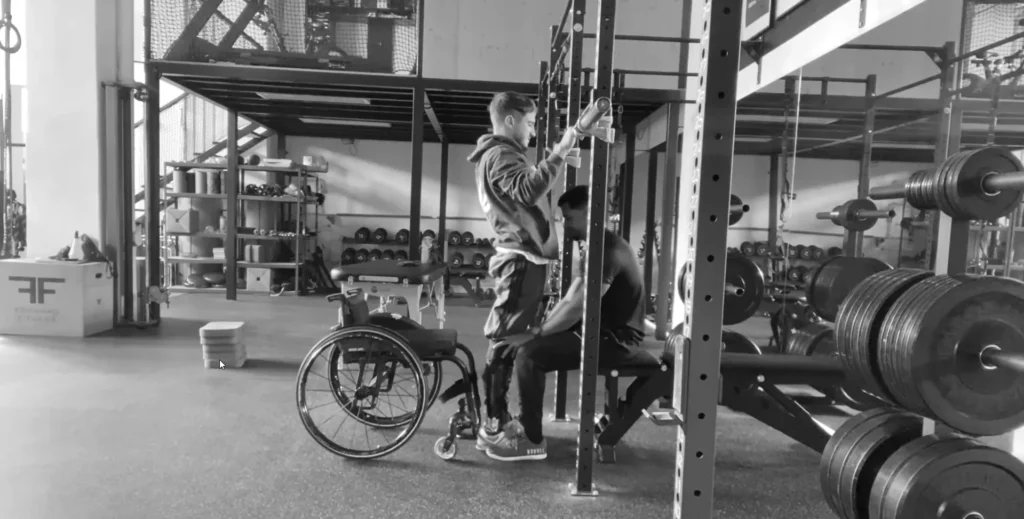

You’ve been told the recovery window closes at 12 months. The neuroscience says otherwise — and it’s time someone said so clearly.
In the months after a spinal cord injury, most people hear a version of the same thing: adapt, accept, this is your new normal.
The intent is often compassionate. The science is increasingly outdated.
I’ve worked as an exercise physiologist specialising in SCI and neurological rehabilitation for 16 years — across California, Brazil, Slovakia, and now Melbourne. In that time, the single most damaging thing I encounter isn’t limited funding or access barriers. It’s the 12-month myth.
The belief that meaningful recovery ends at the one-year mark. It doesn’t.
— — —
The nervous system can rewire itself. This is not hope — it’s biology.
Neuroplasticity is the central nervous system’s ability to reorganise — forming new connections, strengthening dormant pathways, and remapping function in response to stimulus.
For most of the 20th century, medicine assumed the brain and spinal cord were fixed after injury. That view has been fundamentally revised.
After SCI, three neuroplastic processes matter most:
| What happens in the nervous system after SCI:
• Axonal sprouting — intact axons near the injury site form new connections with neurons below the lesion. • Synaptic strengthening — dormant pathways can be reactivated and strengthened through repeated, targeted movement. • Cortical remapping — the brain’s motor cortex reorganises, allocating resources to areas being actively trained. |
Each of these is driven by one thing: the right exercise stimulus, applied consistently by a clinician who knows how to target them.
| Neuroplasticity is not passive. It doesn’t happen through rest or time. It happens through deliberate, progressive exercise — designed specifically for your nervous system. |
What the research actually shows
A landmark 2011 study by Harkema et al. published in The Lancet demonstrated that an individual with motor-complete SCI — clinically no motor function below the lesion — was able to achieve voluntary movement following intensive task-specific locomotor training. Pathways previously thought non-functional were activated through the right combination of stimulus and repetition.
Equally significant: Tashiro et al. (2015) showed measurable neurological recovery — confirmed by electrophysiological testing — in participants who began intensive training more than one year post-injury. Not just functional improvement. Neural-level change, years after injury.
Research by Detloff et al. (2014) added a critical finding on intensity: high-intensity exercise produced significantly greater axonal sprouting and functional recovery than low-intensity training — even when total duration was equal. The dose matters. A low-intensity maintenance program is not simply less effective — it may not be triggering a neuroplastic response at all.
| The 12-month rule is a healthcare system artefact — a product of funding timelines and service capacity, not of what the nervous system can actually do. |
What this means for your exercise program
The difference between a neuroplasticity-focused EP program and a generic exercise program comes down to four things:
- Task-specificity — the nervous system adapts to exactly what you train. Goals drive design.
If you want to improve transfers, the program trains transfers. General fitness doesn’t produce the condition-specific neural adaptations that drive functional recovery.
- Progressive overload — neuroplasticity is driven by challenge.
A program that stays at the same intensity week after week is producing maintenance, not recovery. Planned, progressive increase in demand is the mechanism of neural adaptation.
- Frequency and consistency — neuroplastic benefits are dose-dependent.
The research protocols that produced meaningful outcomes involved multiple sessions per week, sustained over months. This is why removing transport and attendance barriers — through mobile delivery — is clinically significant, not just convenient.
- Clinical expertise in the condition.
Designing an SCI exercise program requires knowledge of ASIA classification, autonomic dysreflexia management, respiratory considerations in cervical injuries, spasticity mechanics, and medication interactions. This is the product of a four-year clinical degree and years of specialist practice — not a weekend course.
Accessing specialist EP in Australia
The most common barrier to specialist EP for SCI participants in Australia is not funding — it’s awareness that the funding exists.
| How to access exercise physiology through your NDIS plan:
• Exercise physiology is funded under Capacity Building — Improved Daily Living (CB-IDL). • If it’s not in your current plan, you can request an unscheduled plan review. This is your right as a participant. • At your planning meeting, say: ‘I’d like to include Exercise Physiology under Capacity Building — Improved Daily Living to support my functional capacity goals.’ • TAC and WorkSafe also fund EP for transport accident and workplace injury — contact us and we’ll liaise directly with your case manager. |
— — —
The bottom line
Spinal cord injury is life-changing. The information that follows it is often defined more by the limits of the healthcare system than by the limits of the human nervous system.
Here is what the science establishes:
- Neuroplasticity continues well beyond 12 months post-injury.
- Task-specific, progressive, high-intensity exercise drives neural adaptation at every stage.
- Specialist exercise physiology produces significantly better outcomes than generic programs.
- Mobile delivery removes barriers that directly affect programme adherence and outcomes.
If you or someone you love has been told that recovery has plateaued — we’d like a conversation. Not to promise outcomes we can’t guarantee. To give you an honest, evidence-based picture of what’s still possible.
The ceiling is almost always higher than you’ve been told.
| Want to know what’s possible for you?
As One Australia provides specialist mobile exercise physiology for people with spinal cord injuries and neurological conditions across Melbourne. Sessions are funded through NDIS Capacity Building, TAC, and WorkSafe. We come to you. Book a free 15-minute discovery call — no obligation, just an honest conversation. 📞 asoneaustralia.com.au | We come to you. |
— — —
| About the author
Felipe is co-founder of As One Australia and an AHPRA-registered Accredited Exercise Physiologist with a Master’s in Exercise Physiology and over 12,000 hands-on clinical hours in neurological rehabilitation across Australia, Brazil, the United States, and Slovakia. As One Australia provides specialist mobile EP for people with neurological and physical disabilities across Melbourne, funded through NDIS, TAC, and WorkSafe. |
| KEY REFERENCES
1. Harkema, S., et al. (2011). Effect of epidural stimulation of the lumbosacral spinal cord on voluntary movement after motor complete paraplegia. The Lancet, 377(9781), 1938-1947. 2. Tashiro, S., et al. (2015). BDNF induced by treadmill training contributes to suppression of spasticity and allodynia after spinal cord injury via upregulation of KCC2. Neurorehabilitation and Neural Repair, 29(7), 677-689. 3. Detloff, M.R., et al. (2014). Delayed exercise is ineffective at reversing aberrant nociceptive afferent plasticity or neuropathic pain after spinal cord injury. Neurorehabilitation and Neural Repair, 30(7), 685-700. 4. Edgerton, V.R., et al. (2004). Plasticity of the spinal neural circuitry after injury. Annual Review of Neuroscience, 27, 145-167. 5. Gorgey, A.S. (2014). Exercise awareness and barriers after spinal cord injury. World Journal of Orthopedics, 5(3), 158-162. |